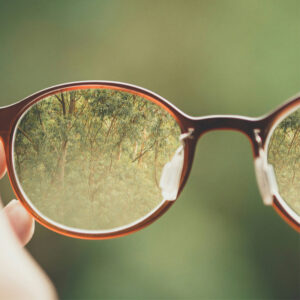
There are two main types of eyeglasses. Single-vision glasses have a lens designed to help you see either close up or far away. Multifocal glasses correct both near and distance vision — all in the same lens. One part focuses for distance vision and the other focuses up close for things like reading.
You will probably need to change your reading glasses prescription from time to time. This is because between the ages of 40 and 60 your eye’s natural lens will continue to lose flexibility. This means you will lose more and more focusing ability.
Some people worry that reading glasses might cause their sight to worsen more quickly. That’s not the case! Delaying the use of reading glasses is of no benefit.
Which Lens Materials Should You Choose for Your Glasses?
The material you choose for your lenses makes a big difference in your glasses. Eyeglass lenses used to be made only of glass, but today most lenses are plastic.
Trivex lenses
Trivex is a newer plastic material. Glasses with trivex lenses meet the same safety standards as polycarbonate. The advantage is that trivex lenses are less distorting than polycarbonate lenses.
High index lenses
High index lenses are thin, lightweight, plastic lenses. Glasses with high index lenses are for people who need high visual correction. Because they are thin, they reduce the “coke bottle” look that comes with thick-lens glasses.

Anti-reflective coatings
Anti-reflective coatings reduce glare. This makes eye contact easier, prevents eyestrain, and improves your appearance. Coated lenses also allow more light to pass through. This improves your ability to see small patterns and letters. These coatings are especially helpful for people bothered by the glare of headlights and other lights while driving at night.
Ultraviolet (UV) coatings
UV coatings helps to protect your eyes from the sun’s harmful radiation. You may not need this type of coating with glasses with some types of plastic lenses. Some plastic lenses block UV light without a special coating.
The Price of Glasses: More Isn’t Necessarily Better
A lot of people want expensive designer frames. But spending more on frames doesn’t mean you’ll end up with better-quality eyeglasses. You don’t need designer frames to have a good set of glasses.
However, don’t skimp on price when it comes to lenses. This is especially true for bifocal, trifocal or progressive lenses. Your optician will help you select good lenses. Lenses with a wide reading area that minimize distortion will be well worth the cost.